PURPOSE
The Ring wave is an oscillatory transient, induced in low-voltage cables due to the switching of electrical networks and reactive loads, faults and insulation breakdown of power supply circuits or lightning. It is, in fact, the most diffused phenomenon occurring in power supply networks, as well as in control and signal lines. Another cause is lightning which itself is characterized by a unidirectional waveform.
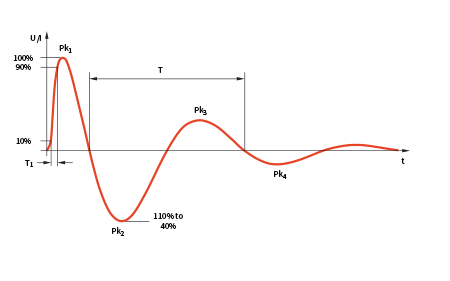
The phenomenon which is created by the above-mentioned effects is an oscillatory transient or a Ring wave. A Ring wave with a defined 0,5 µs rise time and 100 kHz oscillation frequency has been determined to be typical and is widely used for testing products.
|
Level
|
Open circuit test voltage
|
|
Line-to line
|
Line-to-groundb
|
|
1
|
0.25
|
0.5
|
|
2
|
0.5
|
1
|
|
3
|
1
|
2
|
|
4
|
2
|
4
|
|
Xa
|
Special
|
Special
|
“X”can be any level, above, below or in between the others. This Level shall be specified by product committees and/or equipment specification. For symmetrical interconnection lines the test can be applied to multiple lines simultaneously with respect to ground, i.e., “lines to ground”.
Test setup for surges applied to EUT Power ports
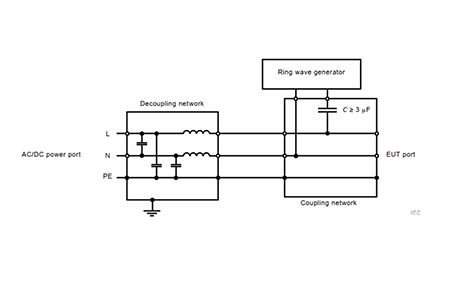
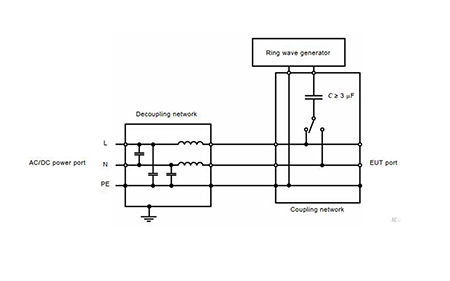
The Ring wave shall be applied to the EUT power supply terminals via a capacitive coupling network. Decoupling networks are required in order to avoid possible adverse effects on equipment not under test that may be powered by the same lines and to provide sufficient decoupling impedance to the Ring wave so that the specified wave may be applied on the lines under test.
1-phase coupling/decoupling network, line-to-line coupling
Click here to Enlarge
1-phase coupling/decoupling network, line-to-ground coupling
Click here to Enlarge
Waveform of the Ring wave (open circuit voltage and short-circuit current)
Click here to Enlarge
Coupling/decoupling network for unshielded interconnection lines

Click here to Enlarge
Test setup for Ring waves applied to shielded lines
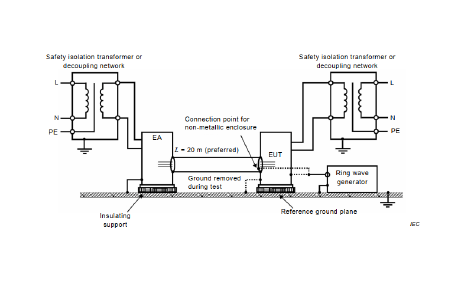
Click here to Enlarge
View our Ring Wave Generator solutions