Skip to content

Defense, Space, and Aerospace

Aerospace, Defense & Space EMC Compliance. From the flight line to the factory floor to the launch pad, mission-critical electronics

Defense, Space, and Aerospace EMC Compliance

From the flight line to the factory floor to the launch pad, mission-critical electronics have to work, the first time, every time. AMETEK CTS brings more than 50 years of EMC test engineering, proven across automotive and IEC compliance testing at global scale, to the standards and platforms that define Aerospace, Defense, and Space.

Aerospace & Defense. From aircraft power quality under MIL-STD-704F, to 28V and 12/24V vehicle systems under MIL-STD-1275E/F and DEF-STAN 61-5 Part 6, to shipboard power under MIL-STD-1399, to equipment-level EMC under MIL-STD-461H, our test systems deliver the precision, repeatability, and traceability these programs demand, backed by global service infrastructure and the stability of AMETEK, Inc.

Space. A new generation of space companies is building differently, designing around mass-produced, commercial electronic components rather than the expensive, low-volume, heritage-qualified parts of the previous era. That shift brings a distinct EMC challenge: these companies need to build or expand test labs quickly, often defining their own compliance standards rather than inheriting one from a legacy prime.
  • Your partner for EMC expertise and compliance +


    Contact us for application assistance Planning a new EMC test capability or upgrading an existing facility?  Our team is available to discuss your application and recommend the most suitable solution.
    Email: sales.cts.eu@ametek.com or you can find your local CTS applications engineer here 
    You can explore our standards-specific resources below.
  • MIL-STD-461H | Electromagnetic Compatibility +


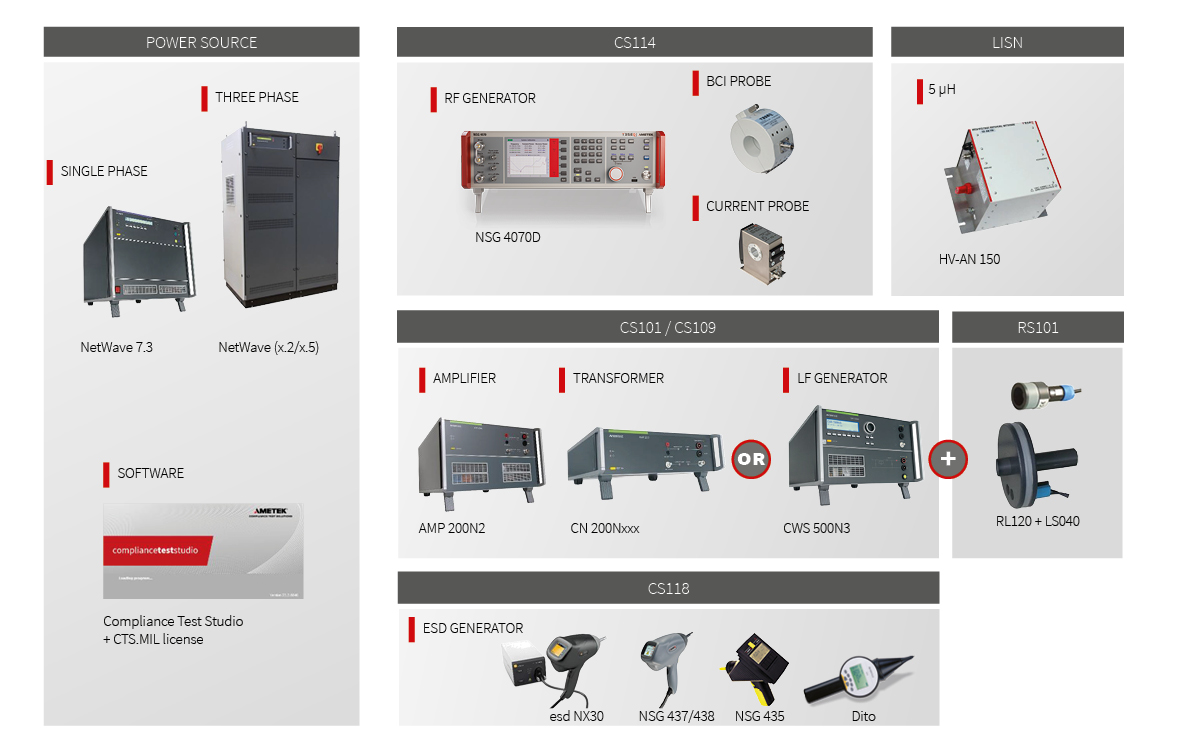
    MIL-STD-461H sets equipment-level EMC requirements for military systems, organized into four families: conducted emissions, conducted susceptibility, radiated emissions, and radiated susceptibility. It applies across aircraft, vehicles, and ships, and works alongside platform-specific power standards like MIL-STD-704 to qualify a system end to end.

    Selecting your test system: the diagram below shows how a complete MIL-STD-461H test setup is built up, from power source through to the coupling network and software needed to run each test.

    Download the full MIL-STD-461H brochure for the complete test breakdown and equipment guide.
    MIL-STD-461

    view product details
     Programmable AC/DC Power Sources technical specification and datasheets
    view product details
    Compliance Test Studio software specification and datasheet
    view product details
    RF Generator NSG 4070D performance specification and datasheet
    view product details
    ESD Simulators technical specification and datasheets
    view product details
    Ripple Generators and Couplers technical specification and datasheets 


    MIL-STD-461H — FAQs

    What is MIL-STD-461H?
    MIL-STD-461H sets equipment-level electromagnetic compatibility (EMC) requirements for military systems, covering emission and susceptibility limits for electrical, electronic, and electromechanical equipment.

    What are the four test families in MIL-STD-461H?
    Conducted emissions (CE101/CE102/CE106), conducted susceptibility (CS101-CS118), radiated emissions (RE101-RE103), and radiated susceptibility (RS101, RS103, RS105).

    What's the difference between MIL-STD-461 and MIL-STD-464?
    MIL-STD-461 tests individual equipment and subsystems; MIL-STD-464 tests entire integrated platforms, such as a complete aircraft or ship.

    What power source is needed for MIL-STD-461H testing?
    A programmable AC/DC source such as NetWave (1-phase or 3-phase), matched to the EUT's power system type (SAC, TAC, SVF, TVF, LDC, or HDC as defined in MIL-STD-704H).

    Which MIL-STD-461H tests does AMETEK CTS equipment cover?
    AMETEK CTS covers CS101, CS109, CS114, CS118, and RS101 with dedicated equipment. Several tests (CE101/102/106, RE101-103, CS103-105, CS115-117, RS105) are not currently covered and require additional test equipment.

    How does MIL-STD-461H relate to MIL-STD-704?
    Test power systems for MIL-STD-461H are drawn directly from the same SAC/TAC/SVF/TVF/LDC/HDC definitions in MIL-STD-704, underlining how closely the two standards are linked in practice.

  • MIL-STD-704F | Aircraft Electrical Power +


    MIL-STD-704F defines the electrical power interface for aircraft systems, setting the voltage, frequency, ripple, and transient characteristics that onboard equipment must tolerate across normal, abnormal, and emergency conditions. It covers six power system types, from constant and variable frequency AC to low- and high-voltage DC, each with its own battery of qualification tests.

    Selecting your test system: the diagram below shows how a complete MIL-STD-704F test setup is built up, from power source through to the coupling network and software needed to run each test.

    Download the full MIL-STD-704F brochure for the complete test breakdown and equipment guide.

    MIL-STD-704F — Aircraft Electrical Power
    view product details
     Programmable AC/DC Power Sources technical specification and datasheets
    view product details
    Compliance Test Studio software specification and datasheet
    view product details
    Ripple Generators and Couplers technical specification and datasheets 

    MIL-STD-704F — FAQs

    What is MIL-STD-704F?
    MIL-STD-704F defines the electrical power interface requirements for aircraft systems, covering voltage, frequency, ripple, and transient characteristics that onboard equipment must tolerate across normal, abnormal, and emergency conditions.

    What equipment is needed to test to MIL-STD-704F?
    A typical setup combines an AC/DC programmable power source (NetWave 7.3 or NetWave x.2/x.5), an integrated power analyzer (Option NWB), and Compliance Test Studio software with the CTS.Military license. Higher-current DC tests add the AutoWave + VDS 200Q 4-quadrant amplifier platform. For ripple tests AMP 200N2/CN 200N2 and CWS 500N3.

    What power system types does MIL-STD-704F cover?
    Six types across AC and DC: SAC/TAC (single- and three-phase AC at constant 400 Hz), SVF/TVF (single- and three-phase AC across 360-800 Hz), and LDC/HDC (28V and 270V DC systems).

    How does MIL-STD-704F relate to MIL-STD-461?
    MIL-STD-704F defines aircraft power quality, while MIL-STD-461 defines equipment-level EMI limits. The two are complementary and often referenced together as part of the broader electromagnetic-environmental-effects framework for aircraft programs.

    What is the difference between MIL-STD-704F and MIL-HDBK-704?
    MIL-STD-704F sets the requirements; the companion handbooks MIL-HDBK-704-1 through -8 translate those requirements into the detailed test procedures used to verify compliance.

    Does AMETEK CTS equipment cover all MIL-STD-704F tests?
    Yes — AMETEK CTS equipment, combined with Compliance Test Studio's pre-programmed standards library, covers the full battery of SAC/TAC, SVF/TVF, and LDC/HDC tests defined in MIL-STD-704F.

  • MIL-STD-1275E/F | 28VDC Military Vehicles +


    MIL-STD-1275E/F governs the 28V electrical systems used across military vehicle platforms, defining the voltage range, ripple, surge, and transient conditions equipment must handle on a shared vehicle power bus. It spans normal operation, engine starting, reverse polarity, and both injected and emitted disturbances on the line.

    Selecting your test system: the diagram below shows how a complete MIL-STD-1275E/F test setup is built up, from power source through to the coupling network and software needed to run each test.

    Download the full MIL-STD-1275E/F brochure for the complete test breakdown and equipment guide.

    MIL-STD-1275E/F governs the 28V electrical systems used across military vehicle platforms
    view product details
     Programmable AC/DC Power Sources technical specification and datasheets
    view product details
    Compliance Test Studio software specification and datasheet
    view product details
    Ripple Generators and Couplers technical specification and datasheets 


    MIL-STD-1275E/F — FAQs

    What is MIL-STD-1275E/F?
    MIL-STD-1275E/F sets the requirements for 28VDC electrical systems on military vehicles, defining the operational voltage range, ripple, surge, spike, and transient conditions equipment must tolerate on a shared vehicle power bus.

    What's the difference between MIL-STD-1275E and Revision F?
    Revision F brought the standard closer into line with automotive and commercial EMC practice, with several emission and immunity tests mapping directly onto MIL-STD-461 CS101 and ISO 7637-2.

    What equipment is needed for MIL-STD-1275 testing?
    A power source (NetWave or VDS 200x with AutoWave), an amplifier or LF generator for injected ripple (AMP 200N2, CN 200Nxxx, or CWS 500N3), LISNs, and Compliance Test Studio with the CTS.Military license.

    How does MIL-STD-1275 relate to automotive EMC standards?
    Several MIL-STD-1275 tests share pulse parameters and test philosophy with ISO 7637-2, making the standard accessible to labs already equipped for automotive transient-immunity testing.

    What tests does MIL-STD-1275E/F include?
    Operational voltage range, injected and emitted ripple, starting/staring events, injected and emitted spikes and surges, and reverse polarity.

    Does AMETEK CTS cover all MIL-STD-1275E/F tests?
    Yes — AMETEK CTS's NetWave, VDS 200Qx.2 with AutoWave, and associated amplifiers, LISNs, and coupling networks cover the full MIL-STD-1275E/F test set.

  • MIL-STD-1399 Section 300 | Shipboard Power +


    MIL-STD-1399 Section 300 sets the electrical interface requirements between Navy shipboard AC power systems and connected equipment, covering three general power types and several special shipboard power classifications alongside a ten-test qualification programme spanning voltage and frequency tolerance, transients, and emissions.

    Selecting your test system: the diagram below shows how a complete MIL-STD-1399 Section 300 test setup is built up, from power source through to the coupling network and software needed to run each test.

    Download the full MIL-STD-1399 Section 300 brochure for the complete test breakdown and equipment guide.

    MIL-STD-1399 Section 300 | Shipboard Power
    view product details
     Programmable AC/DC Power Sources technical specification and datasheets
    view product details
    Compliance Test Studio software specification and datasheet

    MIL-STD-1399 Section 300 — FAQs

    What is MIL-STD-1399 Section 300?
    MIL-STD-1399 Section 300 sets the electrical interface requirements between Navy shipboard AC power systems and connected equipment, defining voltage, frequency, and tolerance characteristics for surface ships and submarines.

    What's the difference between Part 1 and Part 2 of Section 300?
    Part 1 covers low-voltage AC power; Part 2 covers medium-voltage AC. Most equipment qualification testing falls under Part 1.

    What is covered in Part 3?
    Part 3 defines the electrical interface requirements for shipboard equipment that utilizes or supplies low-voltage direct-current (LVDC) power. The standard applies to Type I and Type III power systems with a nominal voltage of 850 VDC, and Type II power systems with a nominal voltage of 875 VDC.


    What shipboard power types does MIL-STD-1399 define?
    Three general types — Type I (standard, 60 Hz), Type II (ungrounded, 400 Hz), and Type III (ungrounded, tighter tolerances) — plus special classifications for zones like hangars, flight decks, and NATO-interoperable equipment.

    What tests are included in MIL-STD-1399 Section 300 Part 1?
    Ten tests spanning grounding susceptibility, equipment power profiling, voltage/frequency tolerance and transient recovery, voltage spikes, emergency conditions, current-waveform emissions, and modulation susceptibility.

    Does AMETEK CTS equipment cover all MIL-STD-1399 Part 1 tests?
    AMETEK CTS equipment covers eight of the ten Part 1 tests; human-body ground current and line-to-ground voltage testing require additional equipment not currently offered.

    How does MIL-STD-1399 relate to MIL-STD-461?
    MIL-STD-1399 Section 300 is the power-quality layer of shipboard EMC qualification, sitting alongside MIL-STD-461 (equipment-level EMI) in the same way MIL-STD-704 does for aircraft.

  • DEF-STAN 61-5 Part 6 — 12V/24V Military Vehicles +


    DEF-STAN 61-5 Part 6 is the UK Ministry of Defence standard for 12V and 24V vehicle electrical systems, covering what a DUT emits back onto the supply (ripple, exported transients, inrush current) and what it must tolerate (earth bonding, cranking, reverse voltage, transients, and load dump).

    Selecting your test system: the diagram below shows how a complete DEF-STAN 61-5 Part 6 test setup is built up, from power source through to the coupling network and software needed to run each test.

    Download the full DEF-STAN 61-5 Part 6 brochure for the complete test breakdown and equipment guide.

    DEF-STAN 61-5 Part 6 — 12V/24V Military Vehicles
    view product details
     Power Source - 4 Quadrant Amplifier technical specification and datasheets
    view product details
    Compliance Test Studio software specification and datasheet
    view product details
    Transient Immunity technical specification and datasheets 


    DEF-STAN 61-5 Part 6 — FAQs

    What is DEF-STAN 61-5 Part 6?
    DEF-STAN 61-5 Part 6 is the UK Ministry of Defence standard governing 12V and 24V electrical systems on military vehicles, currently at Issue 7 (2009).

    How does DEF-STAN 61-5 Part 6 differ from MIL-STD-1275?
    MIL-STD-1275 sets requirements for 28V US military vehicle power; DEF-STAN 61-5 Part 6 covers the more common 12V and 24V levels used on UK and NATO-interoperable platforms.

    What are DET and DIT tests in DEF-STAN 61-5?
    DET tests measure what the DUT emits back onto the supply (ripple, exported transients, inrush current); DIT tests measure what the DUT must tolerate (supply isolation, earth bonding, cranking, reverse voltage, transients, load dump).

    What equipment does DEF-STAN 61-5 Part 6 testing require?
    A 4-quadrant amplifier (VDS 200Qx.2 with AutoWave), transient/load-dump generators (UCS 200N, LD 200N), LISNs (HV-AN 150, AN 200N100), and Compliance Test Studio with the CTS.Military license.

    How does DEF-STAN 61-5 relate to automotive standards?
    Several DIT tests reference the same pulse parameters as ISO 7637-2 and ISO 16750-2, making the standard one of the more accessible in this series for labs already equipped for automotive transient testing.

    Does AMETEK CTS cover all DEF-STAN 61-5 Part 6 tests?
    Yes — all eleven DET and DIT tests are covered, with one (negative earth bonding isolation) requiring only a standard multimeter rather than dedicated AMETEK CTS equipment.