Unlocking Possibilities
Partner with AR Amplifiers for unmatched amplifier solutions in Aerospace and Defense
In the fast-evolving Aerospace and Defense market, choosing the right amplifier solution for your application is critical to ensuring mission success and operational performance. At AR Amplifiers, we deliver industry-leading technology and reliability, making us the preferred partner for advanced amplification needs.
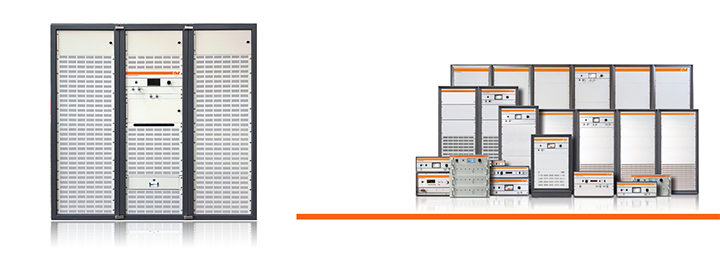
World-Class innovation
Our state-of-the-art, standard product and custom-built amplifiers offer frequency levels up to 40GHz and power levels exceeding 500KW (pulsed), providing unmatched capabilities for the most demanding applications. Our solutions are designed to effortlessly replace existing TWTA-based systems, ensuring a swift and efficient enhancement of your overall operational capabilities.
Aerospace and defense applications of High Power Solid State Amplifiers
When it comes to pushing the boundaries of technology and ensuring the reliability of electronic systems, high power solid state amplifiers play a pivotal role in many A&D applications. Here’s a glimpse into the diverse realms where these amplifiers are instrumental:
HIRF (High-Intensity Radiated Field) Testing
HIRF (High-Intensity Radiated Field) testing involves specific modulation schemes or pulse characteristics to simulate several types of electromagnetic threats. HIRF is a crucial aspect of ensuring the electromagnetic compatibility and safety of electronic systems, particularly in the A & D industry. High-intensity electromagnetic fields are simulated to evaluate how well electronic systems, such as avionics, weapons and other critical components, can withstand and operate within such environments. Main needs are 1-18 GHz with pulsed power up to 1MW and more.
NEMP (Nuclear Electromagnetic Pulse) Testing
NEMP testing involves the simulation of the electromagnetic pulse generated by a nuclear detonation. The purpose of NEMP testing is to evaluate the resilience of electronic systems and critical infrastructure to the intense electromagnetic fields produced during a nuclear explosion. Amplifiers are used to generate the high-power electromagnetic pulses needed for testing. Main needs are in the 1-400 MHz range, with pulsed power up to 500 kW.
Component Test
Component test setups with amplifiers generating interference signals, allowing engineers to assess how well communication components can tolerate and reject unwanted signals. This is crucial in ensuring reliability against interference in real-world environments. Filters, duplexers, and other frequency-selective components are tested with the amplifiers generating signals that allow engineers to characterize the performance of these components in terms of IMD, bandwidth, insertion loss, and rejection.
RF components, such as filters, attenuators, and cables are also tested. This involves measuring parameters like gain, noise figure, and distortion to ensure that components meet specifications. Main amplifier needs are in the .5 to 12 GHz segment, with CW power up to 1 kW.
EW (Electronic Warfare) Jamming and Jamming Simulation
Electronic warfare systems to amplify the power of jamming signals to disrupting enemy communication and radar systems. Along with electronic countermeasures to amplify signals designed to deceive or neutralize enemy radar and communication systems.
Jamming simulation signals that reproduce the electronic interference and power levels created by hostile forces. Signals are directed toward the system under test to evaluate its ability to operate effectively in the presence of jamming. Main needs are 20 MHz-10 GHz with CW or pulsed power up to a few kW
EW (Electronic Warfare) Destruction
As with EW jamming and jamming simulation, EW destruction involves generating high power levels to overpower and damage enemy radar and threats as well as assessing the resilience of electronic systems, vehicles, drones, aircrafts and missiles to various destruction attack scenarios.
Radar and radar simulation
Pulse and continuous (CW radar exist but are exceptional) wave amplifiers are used in radar systems helping/ allowing to boost the power of transmitted signals and improve the detection range, accuracy, surveillance and tracking radar enhancing target detection and tracking capabilities.
Radar simulators (versus Operating Radars) are used in laboratory to ensure that electronic devices can operate properly in the presence of electromagnetic interference (EMI). Amplifiers boost the intensity of electromagnetic fields to the desired level which the device under test (DUT) is exposed. (Simply as an EMC test procedure) Main needs are 1-18 GHz with pulsed power from 5 kW up to 1 MW. Radiated Immunity Poster_2022_Update
Solid State Amplifiers | WORLD FIRSTS
With over two decades of experience in the defense sector, AR possess a deep understanding of the distinctive needs within this specialized market. Our track record includes successfully addressing challenges for global defense organizations through groundbreaking applications of solid-state amplifiers, marking several world-first achievements.
| Frequency |
Power Level |
Amplifier Type |
Customer |
Country |
Application |
| 1.0-6.0GHz |
3 kW |
CW |
European Defence Agency |
France |
HIRF EMC (High Intensity Radiated Fields) Radar |
| 0.1-1.0GHz |
10 kW |
Pulse |
U.S. Department of Defense |
USA |
Electronic Warfare |
| 1.0-6.0GHz |
5 kW |
Pulse |
U.S. Department of Defense |
USA |
Electronic Warfare |
| 1.0-6.0GHz |
50 kW |
Pulse |
European Defense Agency |
Germany |
Radar & Electronic Warfare |
| 1-400MHz |
80 kW |
Pulse |
U.S. Department of Defense |
USA |
NEMP (Nuclear Electromagnetic Pulse) |
| 8.5-10.5GHz |
30KW |
Pulse |
U.S. Department of Defense |
USA |
Electronic Warfare |
| 0.1-1.0GHz |
150KW |
Pulse |
U.S. Department of Defense |
USA |
HIRF EMC (High Intensity Radiated Fields) Electronic Warfare |